
Table of Contents
- What Drives Residential Roof Replacement Cost Estimates
- Factors Affecting Roof Replacement Cost: A Full Breakdown
- Average Cost of Roof Replacement by Square Footage
- Roofing Material Types and Their Cost Impact
- Hidden Costs Most Roofing Estimates Leave Out
- How to Get Accurate Roofing Quotes Without Getting Burned
- Roof Replacement Financing Options for Homeowners
- Making a Confident Decision on Your Roof Replacement
Last Updated: August 3, 2026
Getting accurate residential roof replacement cost estimates is one of the most financially consequential decisions a homeowner will make. The range is genuinely wide, and the variables that drive the final number are more complex than most roofing calculators let on. At Alpha Guard, we work with McAllen-area homeowners every week who arrive with ballpark figures from the internet and leave with a clearer, more honest picture of what their specific roof actually requires. Below, we’ll walk through every major cost driver, explain what most estimates quietly leave out, and show you how to protect yourself from scope creep and surprise charges.
What Drives Residential Roof Replacement Cost Estimates
Roof replacement cost estimates are not one-size-fits-all. The final number depends on roof pitch, material choice, your region’s labor market, and what’s hiding underneath your shingles.
Roof Pitch and Structural Complexity
Roof pitch is the steepness of your roof, measured as the rise over a 12-inch horizontal run. A low-slope roof at 3:12 pitch is straightforward to work on. A steep 9:12 or 12:12 pitch requires safety equipment, slower installation, and more labor hours. Contractors typically apply a pitch multiplier to their base square footage price once the slope exceeds around 7:12.
Complexity compounds pitch. A simple gable roof costs less to replace than a hip roof with multiple valleys, dormers, and skylights. Each transition point requires precise flashing work and additional material cuts.
Never accept a roofing estimate that doesn’t specify how roof pitch was factored into the price. If a contractor gives you a flat per-square price without mentioning slope, ask directly. Vague estimates are where scope creep begins.
Tear-Off, Decking, and Disposal Fees
The tear-off process removes your existing roofing system down to the decking and generates significant debris. Disposal fees vary by local landfill rates and haul distance.
Once the old material is stripped, the roof decking gets inspected. Decking compromised by moisture, rot, or pest damage must be replaced before new materials go down. This is one of the most common sources of unexpected cost in a roof replacement project. A contractor who hasn’t physically inspected your decking cannot give you a truly firm estimate.
Factors Affecting Roof Replacement Cost: A Full Breakdown
Labor Costs vs. Material Costs
Labor and materials typically represent the two largest line items in any roofing estimate. The split varies by material type and regional market conditions. Labor-intensive materials like slate or tile require specialized installation skills, which shifts the ratio toward labor. Standard asphalt shingles are more forgiving to install, so material cost carries more weight.
In South Texas markets like McAllen, labor costs reflect regional expertise with intense UV exposure, heat cycling, and severe storms. According to the National Roofing Contractors Association’s contractor resources, labor costs in roofing projects can account for 40% to 60% of the total project cost depending on material complexity and regional wage rates.
Building Permits, Flashing, and Underlayment
Building permits are required for most full roof replacements. Permit fees are set at the local level, so McAllen homeowners should verify current fees with the City of McAllen’s building department.
Flashing is the metal material installed at transitions: around chimneys, skylights, vents, and roof valleys. Old flashing is often reused to cut costs, but corroded or improperly installed flashing is a leading cause of post-replacement leaks. New flashing should be a standard line item.
Underlayment, the material installed between the decking and shingles, is your secondary moisture barrier. Ice and water shield protects eaves and valleys. Drip edge directs water away from the fascia. These components are not optional accessories; they are structural elements of a code-compliant roofing system.
| Component | Function | Common Omission Risk |
|---|---|---|
| Underlayment | Secondary moisture barrier | Swapped for lower-grade product |
| Ice and water shield | Protects eaves and valleys | Skipped in warm climates |
| Drip edge | Directs water from fascia | Left off budget estimates |
| Flashing | Seals transitions and penetrations | Old flashing reused without inspection |
| Ventilation | Regulates attic temperature | Overlooked entirely |
Average Cost of Roof Replacement by Square Footage
Roofing is priced in "squares," where one roofing square equals 100 square feet of roof surface. A typical single-story home in the McAllen area has a roof surface area significantly larger than the home’s footprint because of roof pitch and overhangs.
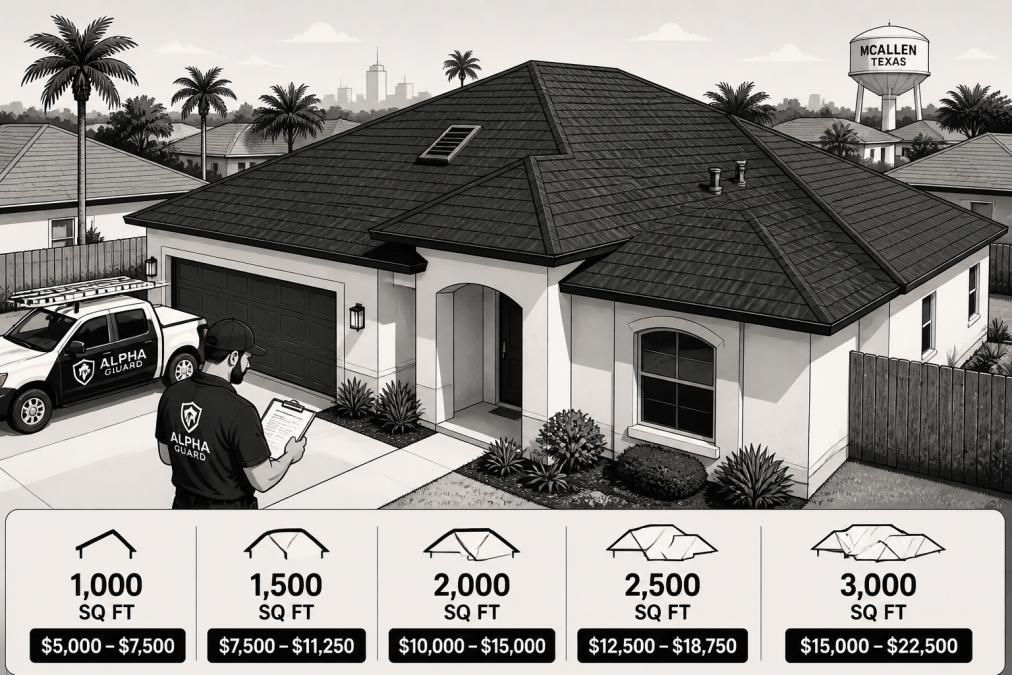
How to Calculate Your Roof Size in Roofing Squares
- Measure the length and width of your home’s footprint in feet.
- Multiply length by width to get the base square footage.
- Apply a pitch multiplier: flat roofs use 1.0, a 4:12 pitch uses approximately 1.06, a 6:12 pitch uses approximately 1.12, and a 9:12 pitch uses approximately 1.25.
- Divide the adjusted square footage by 100 to get the number of roofing squares.
- Add 10% to 15% for material waste from cuts and overlaps.
A contractor’s on-site measurement will be more precise because it accounts for dormers, valleys, and penetrations that add surface area.
Regional Labor Market Variance: Why McAllen Pricing Differs
McAllen sits in a distinct regional labor market. Roofing labor rates here differ from what you’d see quoted in Dallas, Houston, or Austin. According to the U.S. Bureau of Labor Statistics Occupational Employment and Wage Statistics, construction and extraction occupations show meaningful wage variation across Texas metropolitan areas, with South Texas generally tracking below the state average for hourly wages. That can translate to lower labor cost per square for McAllen homeowners, but you should be skeptical of estimates dramatically below the local norm, which often signals cut corners rather than genuine efficiency.
Roofing Material Types and Their Cost Impact
Material choice is the single decision with the greatest impact on both upfront cost and long-term performance.
Asphalt Shingles vs. Metal Roofing: Long-Term ROI
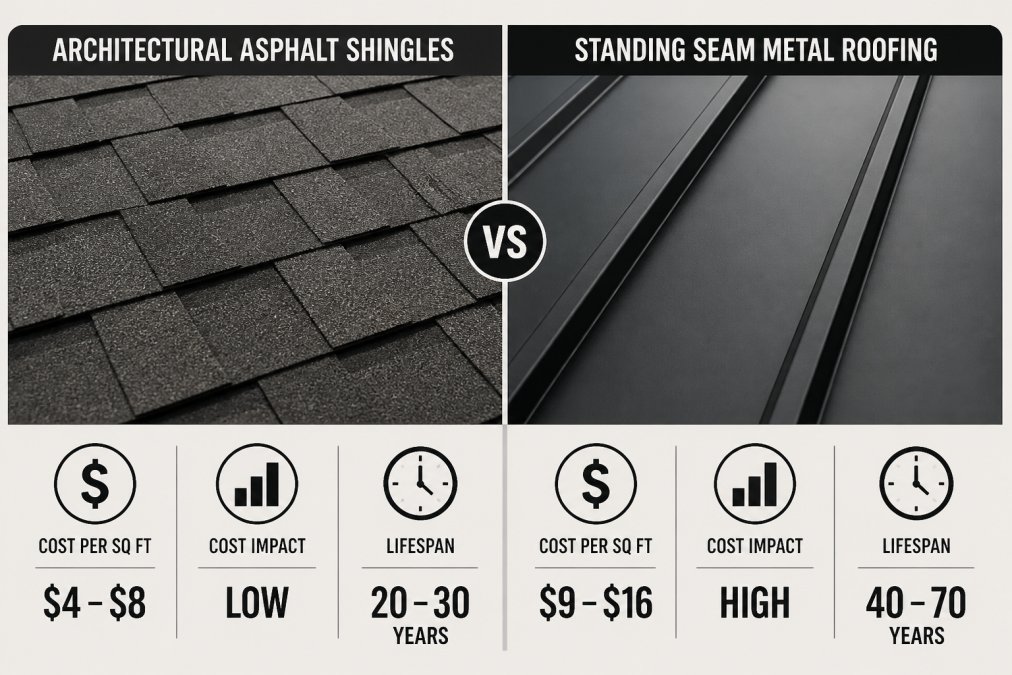
Asphalt shingles are the dominant roofing material in the United States. Architectural shingles offer better wind resistance, a longer manufacturer warranty, and a more textured aesthetic than three-tab shingles. For most McAllen homeowners, architectural shingles represent the practical sweet spot between cost and performance.
Metal roofing occupies a higher upfront cost tier but carries a compelling long-term ROI argument. Standing seam metal roofing systems can last 40 to 70 years with minimal maintenance. In South Texas, where UV exposure and thermal cycling are extreme, metal’s dimensional stability is a genuine advantage. The material doesn’t absorb heat the same way asphalt does, which can contribute to lower cooling loads.
In McAllen’s climate, ask your contractor specifically about solar reflectance ratings for any material you’re considering. A roofing system with a higher solar reflectance index can meaningfully reduce attic temperatures during peak summer months, which translates directly to HVAC savings over the life of the roof.
Hidden Costs Most Roofing Estimates Leave Out
A roofing estimate is a document built on assumptions, and every assumption that turns out to be wrong becomes a change order.
Structural Repairs: Roof Decking, Ventilation, and Ice and Water Shield
Roof decking damage is the most common hidden cost in a replacement project. Moisture that has infiltrated your roofing system over time can cause decking panels to soften, delaminate, or develop mold. You won’t know the full extent until the old roofing material is stripped. Contractors who promise a firm fixed price before tear-off are either very confident in your roof’s condition or building in a margin to cover the unknown.
Ventilation is another overlooked cost center. A roofing system’s structural integrity depends on proper attic ventilation. Inadequate ventilation traps heat and moisture in the attic, which degrades both the decking and the shingles from below.
Ice and water shield is standard in cold climates but sometimes skipped in South Texas on the assumption that ice isn’t a concern. That’s a mistake. Ice and water shield’s primary value in warm climates is wind-driven rain protection, and McAllen gets plenty of that during storm season.
Insurance Claim vs. Out-of-Pocket: Which Path Costs Less
Roof damage from hail, wind, or storm events may be covered under your homeowner’s insurance policy. Filing an insurance claim changes the financial equation significantly.
The out-of-pocket path makes sense when damage is minor and repair costs fall below your deductible, your roof is near the end of its useful life, or you want to avoid a potential premium increase after a claim.
The insurance claim path makes sense when storm damage is documented and clearly exceeds your deductible, your policy covers replacement cost value rather than actual cash value, or a licensed public adjuster or your contractor can document the damage thoroughly.
Before deciding between an insurance claim and paying out of pocket, get a written damage assessment from a licensed roofing contractor. That document is your baseline for both paths and protects you regardless of which direction you go.
According to the Texas Department of Insurance consumer resources, Texas homeowners have specific protections around claim timelines and insurer response requirements that are worth understanding before you file.
How to Get Accurate Roofing Quotes Without Getting Burned
The biggest mistake homeowners make is treating roofing quotes as comparable documents. Two quotes for the same job can differ by thousands of dollars because they’re built on different assumptions about materials, labor scope, and included components.
Here’s a practical checklist for evaluating roofing estimates:
- Does the quote specify the exact shingle brand, product line, and warranty tier?
- Is underlayment type and weight specified?
- Are ice and water shield and drip edge included as line items?
- Is new flashing included, or is old flashing being reused?
- Does the quote address decking replacement and at what cost per panel?
- Are disposal fees and permit costs itemized separately?
- Is the contractor licensed and insured in Texas?
- Is there a written warranty on workmanship separate from the manufacturer’s material warranty?
A contractor who resists providing this level of detail is telling you something important.
Signs You Need a Replacement, Not Just a Repair
Roof repair is the right call when damage is isolated and the surrounding roofing system has meaningful remaining life. Replacement is the right call when shingles are curling, cupping, or losing granules across large areas; the roof is approaching or past its expected lifespan; multiple leaks are appearing in different locations; decking damage is widespread; or a roof inspection reveals systemic failure rather than isolated damage.
A professional roof inspection, conducted by a certified contractor, is the only reliable way to make this determination.
Roof Replacement Financing Options for Homeowners
Roof replacement is a significant capital expense, and paying for it out of pocket isn’t always practical or necessary. Common financing options include home equity loans or HELOCs, personal loans, contractor financing programs, FHA Title I Property Improvement Loans, and insurance proceeds. Check the HUD Title I Property Improvement Loan program details for current eligibility requirements.
Alpha Guard offers affordable financing options designed to make quality roofing accessible to McAllen homeowners without locking you into terms that don’t work for your budget.
Making a Confident Decision on Your Roof Replacement
Accurate residential roof replacement cost estimates require more than a square footage calculation and a material price list. The real number emerges from a site-specific assessment that accounts for pitch, decking condition, accessory components, local labor rates, and the scope of any hidden structural issues.
The more specific your information, the more accurate your estimate, and the less likely you are to face a change order that blows your budget. Detailed estimates protect homeowners.
Roof replacement decisions carry real financial and structural consequences, and McAllen homeowners deserve a contractor who is transparent from the first conversation. Alpha Guard brings certified and insured professionals to every project, backs its work with guaranteed structural workmanship, and offers affordable financing options so cost doesn’t force a compromise on quality. Get a Free Estimate from Alpha Guard and start your project with a clear, detailed picture of what your roof actually needs.
Frequently Asked Questions
How much does it cost to replace a roof on a 2,000 sq. ft. house?
Roof replacement cost estimates for a 2,000 sq. ft. house vary based on roofing material, roof pitch, labor rates in your area, and whether structural repairs are needed. Asphalt shingles are generally the most affordable option, while metal roofing costs more upfront but lasts longer. In South Texas markets like McAllen, regional labor rates and climate-specific material requirements also affect the final figure. Contact a certified local contractor for an accurate, site-specific quote rather than relying on national averages.
What factors influence the total cost of a residential roof replacement?
Several factors affect residential roof replacement cost estimates: roof size measured in roofing squares, pitch and slope complexity, roofing material chosen, tear-off and disposal fees, underlayment and flashing requirements, local building permit costs, and any hidden structural repairs to the roof decking or ventilation system. Labor costs vary significantly by region. In markets like McAllen, TX, heat and humidity add specific material performance requirements that can shift both material selection and installation complexity.
Is it cheaper to repair or replace a roof?
Repairs cost less upfront, but repeated patching on a roof past its service life adds up quickly and can mask deeper structural integrity problems. A general industry guideline suggests that if repair costs exceed 25-30% of a full replacement, replacement is the smarter investment. A professional roof inspection will identify whether issues are isolated or systemic. For homeowners filing an insurance claim after storm damage, replacement is often covered where partial repairs are not.
How do material choices like metal vs. asphalt shingles impact roof replacement costs?
Asphalt shingles, including architectural shingles, carry lower upfront material and installation costs and remain the most common choice for residential roofing. Metal roofing costs more initially but offers a longer service life, better energy efficiency in hot climates like McAllen, and stronger warranty coverage. Over a 30-40 year period, metal roofing can deliver a better return on investment despite the higher starting price. The right choice depends on your home improvement budget, how long you plan to stay in the home, and local weather demands.
Are there financing options available for roof replacements?
Yes. Homeowners have several roof replacement financing options: personal home improvement loans, home equity lines of credit (HELOCs), manufacturer financing programs, and contractor-offered payment plans. Some roofing companies, including Alpha Guard, offer flexible financing so you can move forward without delaying a necessary replacement. Separately, check whether your homeowner's insurance policy covers damage-related replacement, which can significantly reduce or eliminate your out-of-pocket cost. Always review interest rates and repayment terms carefully before committing to any financing arrangement.
This article was written using GrandRanker