
Table of Contents
- Assess Your Drainage Problem Areas
- Grading and Drainage Design Basics
- Choose the Right Drainage System for Your Yard
- French Drain Installation Cost and Considerations
- Landscaping Ideas for Wet Backyards
- Permitting and Local Code Compliance
- DIY vs. Professional Installation
- Conclusion
Last Updated: August 20, 2026
Assess Your Drainage Problem Areas
The first step in designing a custom backyard for drainage is identifying where water pools and how it moves across your property. Walk your yard during or immediately after rainfall and note where water collects, flows, and stays saturated longest.
Look for telltale signs: patches of dead grass, algae growth, compacted muddy areas, or soil that remains soggy days after rain stops. Check your foundation perimeter, water pooling near the house can lead to basement flooding or structural damage. Examine low spots in your lawn, areas beneath downspouts, and anywhere slope naturally directs water.
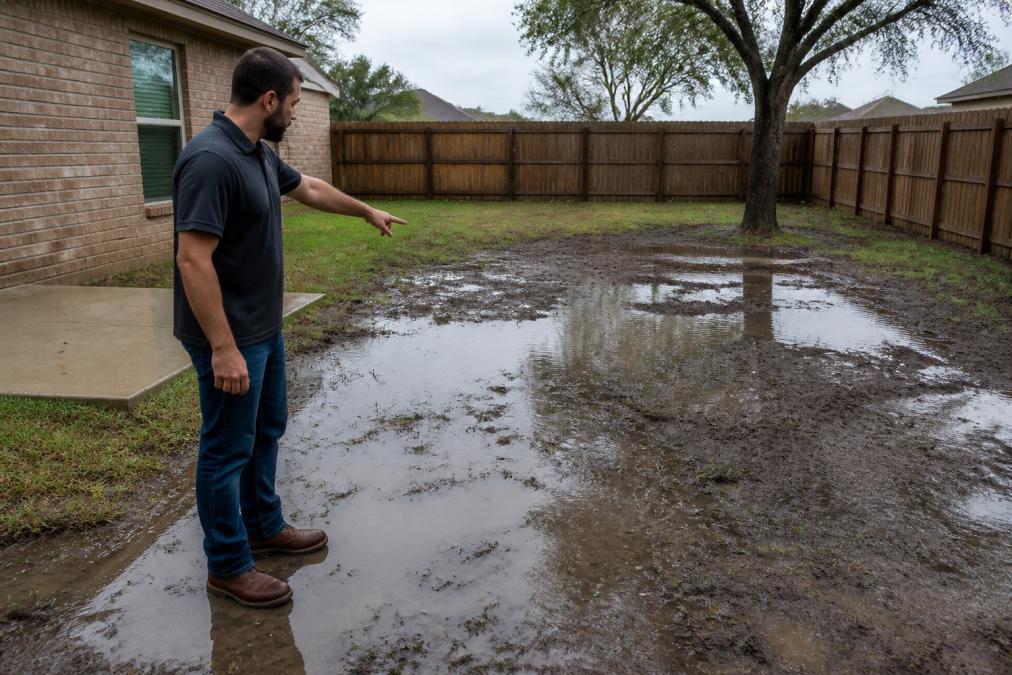
Document problem areas with photos and notes about timing. Does the area drain within hours or stay wet for days? Is the issue seasonal or year-round? Understanding severity and frequency helps determine which solution will work best.
Pay attention to existing landscape features too. Trees with shallow root systems can block water movement, while dense clay soil resists percolation. Hard surfaces like patios and driveways create impermeable barriers that redirect water elsewhere.
Check your local weather records for annual rainfall and seasonal patterns. Knowing whether your area gets occasional heavy storms or frequent moderate rain helps size your drainage system correctly.
Grading and Drainage Design Basics
Grading is the foundation of any effective drainage strategy. It refers to the slope and contours of your yard, how much elevation change exists and in which direction. Proper grading moves water away from structures and toward designated drainage areas using landscape grading principles that work with gravity.
The ideal slope for residential yards is a minimum of 1-2% grade, meaning the ground drops 1-2 feet in elevation for every 100 feet of horizontal distance. This gentle slope looks natural and moves water effectively without creating visible erosion.
When designing a custom backyard for drainage, grading accomplishes several goals: it protects your foundation by directing water away from the house, prevents soil saturation in planting areas, and creates natural pathways for surface runoff. Effective grading reduces or eliminates the need for additional drainage systems.
Analyze your yard’s current topography. Does it slope toward your house (bad) or away from it (good)? Are there low spots that create natural collection points? A professional surveyor can measure exact elevations, but you can also observe water flow during rain to understand your yard’s natural drainage patterns.
Regrading typically involves moving soil, cutting from high areas and filling low spots. This substantial work often requires heavy equipment but is one of the most effective long-term solutions for drainage problems. Consider how grading changes affect your overall landscape, regrading can alter where you can plant trees, where patios sit, and how the yard looks from the house.
Choose the Right Drainage System for Your Yard
Once you understand your drainage problem and have optimized grading where possible, you may need to install a drainage system. Three main types serve different purposes and suit different situations.
French Drain Systems
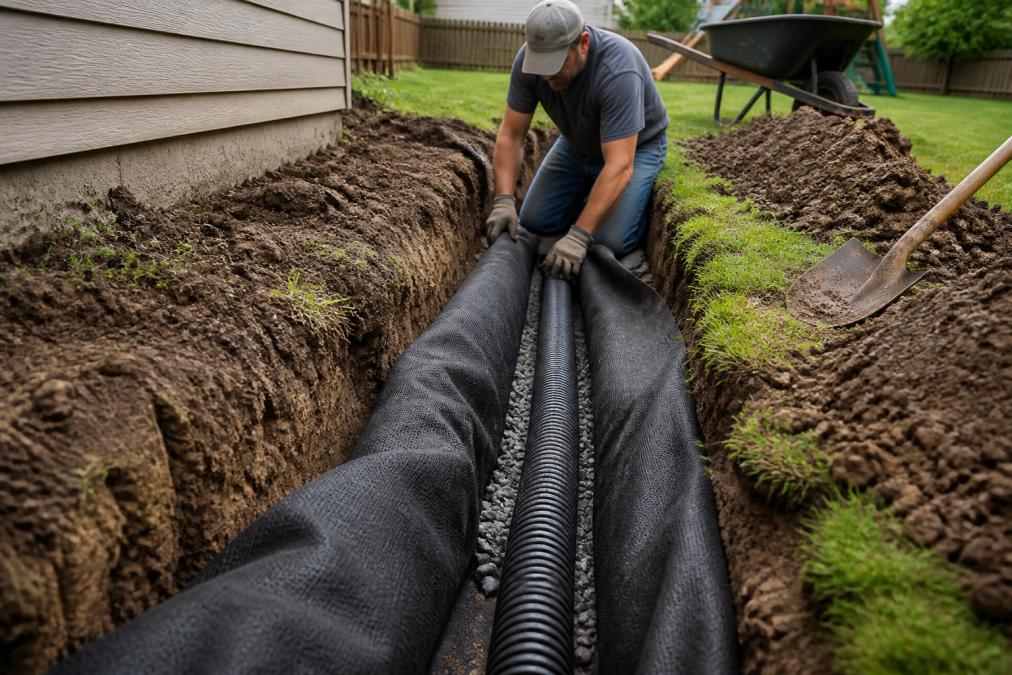
A French drain is a subsurface drainage system that collects water underground and directs it away from problem areas. It consists of a perforated pipe wrapped in geotextile fabric, buried in a trench filled with gravel or stone. Water percolates through the soil, enters the perforated pipe, and flows to a discharge point, typically a storm drain, dry well, or daylight outlet at a lower elevation.
French drains work best for areas with poor percolation or persistent water saturation. They’re invisible once installed and handle large volumes of water while integrating well with landscape plantings.
Installation involves digging a trench 2-4 feet deep, depending on the water table and soil conditions. The depth must be below the frost line in cold climates to prevent freezing damage. The trench slopes gently toward the discharge point, typically a 0.5-1% slope. The pipe is usually 4-6 inches in diameter with small perforations that allow water entry while filtering out soil particles. Geotextile fabric prevents soil from clogging the perforations, while gravel surrounding the pipe provides a pathway for water movement and acts as a filter.
A custom backyard design for drainage using French drains requires careful planning of the trench route to avoid existing utilities and integrate with your landscape design.
Surface Drainage and Swales
Surface drainage systems handle water that flows across the top of the ground. A swale is a shallow, vegetated channel that directs surface runoff toward a collection point. Unlike a ditch, a swale is gently sloped and planted with water-tolerant vegetation that stabilizes soil and filters runoff.
Swales work well for yards with significant slope or high runoff volume. A dry creek bed is a decorative variation that uses stone and drought-tolerant plants to create a naturalistic channel that handles occasional water flow while looking like a natural landscape feature during dry periods.
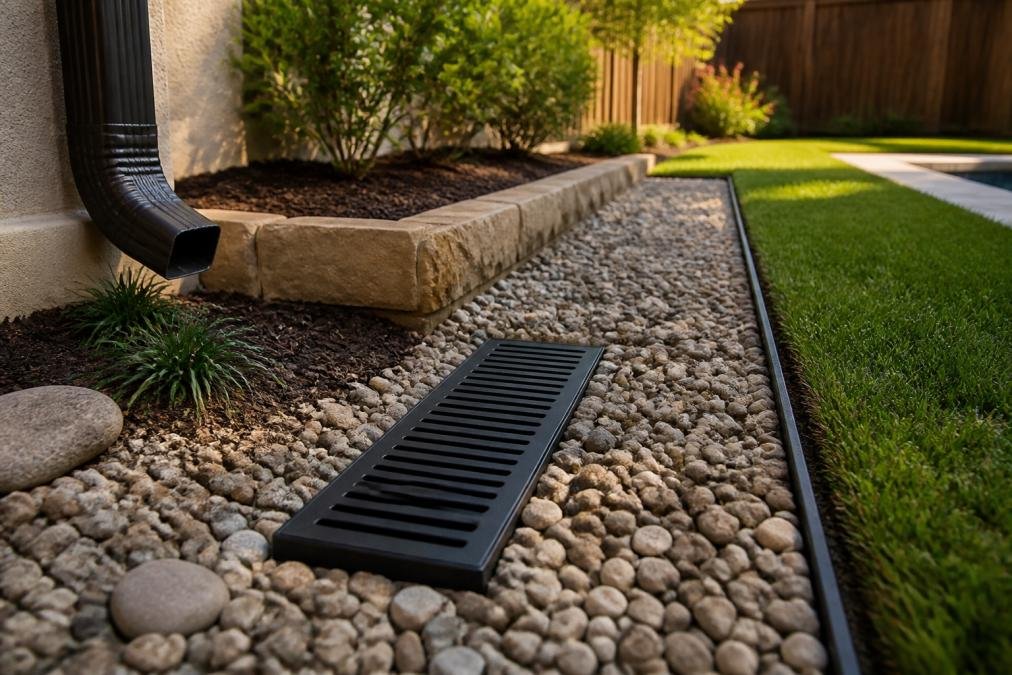
Channel drains and catch basins are more formal surface drainage systems. A channel drain is a linear grate-covered trench that collects water from a specific area. A catch basin is a below-grade box that collects water from multiple sources and connects to an underground pipe system.
Channel and Catch Basin Drains
Catch basins are practical for areas where water collects from multiple directions. A typical catch basin is a 12-18 inch square or circular box buried in the ground with a grate on top. Water flows into the basin through the grate, where sediment settles to the bottom. A pipe at the basin’s base carries water away to a discharge point.
Catch basins require periodic maintenance to remove accumulated sediment and debris. They’re most useful where surface runoff concentrates, like low points in driveways or areas beneath downspout extensions.
Channel drains serve a similar purpose but cover a linear area. These work well along patios, decks, or the edge of hardscape areas where water naturally flows.
Your choice among these three drainage system types depends on several factors. If you have poor-draining soil and subsurface saturation, a French drain addresses the root cause. If you have steep slopes and significant surface runoff, a swale or channel drain handles the water flow. A custom backyard design for drainage often combines multiple systems, landscape grading to direct water, a swale to handle surface runoff, and a French drain for areas with poor percolation.
French Drain Installation Cost and Considerations
French drain installation requires excavation, materials, and labor. Total cost depends on trench length, depth, soil conditions, and local labor rates. A typical residential French drain system might extend 50-200 feet.
Material costs include the perforated pipe, geotextile fabric, gravel, and any necessary discharge components. Labor is typically the larger expense. Equipment rental for excavation adds to the cost if you don’t hire a contractor with their own equipment.
The decision between DIY installation and professional installation depends on your comfort level with heavy equipment and your understanding of proper slope and discharge planning. DIY installation can save money but requires precision, improper slope or drainage planning means the system won’t work effectively. Professional contractors bring expertise in assessing your specific drainage problem, designing appropriate systems, and ensuring proper installation. They understand local soil conditions, frost lines, utility locations, and building codes.
Maintenance is minimal for properly installed French drains. Periodic inspection ensures the discharge point remains clear and water is flowing.
Never install a French drain without locating underground utilities first. Hitting an electrical line, gas line, or water main can be dangerous and expensive. Call 811 (the national utility locating service) before digging.
Landscaping Ideas for Wet Backyards
Once your drainage system is installed and working, you can landscape the area with plants that thrive in wet conditions. Water-tolerant vegetation stabilizes soil, adds visual appeal, and reinforces your drainage design.
Native plant species adapted to your region typically perform best. A rain garden, a planted depression that collects runoff and allows it to percolate slowly, combines drainage function with attractive landscaping. Along swales and drainage channels, consider native grasses and sedges that tolerate periodic inundation.
For areas that are wet but not actively draining, shade-tolerant plants like ferns, hostas, and coral bells create lush planting beds. Permeable pavers in patios and pathways allow water to percolate through rather than creating runoff, reducing the total water volume your drainage system must handle.
A custom backyard design for drainage that incorporates attractive landscaping solves the functional problem while improving your property’s appearance.
Permitting and Local Code Compliance
Drainage work often requires permits, depending on your location and project scope. Contact your local building department or public works office to ask about drainage permit requirements.
Building codes typically address drainage depth (below the frost line), slope requirements, and discharge location standards. Codes exist to prevent damage to neighboring properties and public infrastructure. You generally cannot discharge directly into a neighbor’s property. Daylight discharge (where water flows out at a lower elevation on your own property) is often the preferred solution.
Professional contractors familiar with local codes and permitting processes handle these requirements as part of their service.
DIY vs. Professional Installation
The decision between doing the work yourself and hiring a professional contractor involves several practical considerations. DIY installation saves labor costs but requires your time, equipment access, and technical knowledge. Simple surface drainage like a swale might be manageable as a DIY project. Subsurface systems like French drains require more precision.
Professional installation is recommended for complex drainage problems, large systems, or situations where mistakes are costly. A contractor can assess your specific conditions, design an appropriate system, handle permitting, and ensure proper installation. They carry liability insurance that protects you if something goes wrong.
Cost varies significantly based on system type, yard size, soil conditions, and local labor rates. Get multiple quotes from licensed contractors and check references.
The most important factor in drainage system success is proper design and installation. A well-designed system that addresses your specific problem lasts decades with minimal maintenance. Whether you do the work yourself or hire a contractor, getting the design right is non-negotiable.
Conclusion
A custom backyard design for drainage solves standing water and soil saturation problems while improving your property’s functionality and appearance. The process begins with identifying problem areas, optimizing grading to work with gravity, and selecting appropriate drainage systems for your specific conditions.
At Alpha Guard, our certified and insured professionals help homeowners design and install drainage systems that protect their properties and create beautiful outdoor spaces. We assess your specific drainage challenges, recommend solutions tailored to your yard’s conditions, and handle installation with guaranteed structural workmanship. Our team understands local code requirements and ensures your system complies with regulations while solving your water management problems. Get a Free Estimate from Alpha Guard and discover how custom backyard design for drainage can transform your wet yard into a functional, attractive outdoor living area.
Frequently Asked Questions
How can I create better drainage in my yard?
Start by assessing problem areas where water pools. Regrade the landscape to slope away from structures, install a French drain or surface drainage system, and manage downspout runoff. For wet backyards, add water-tolerant plants and permeable surfaces. The best approach depends on your soil type, water table depth, and local topography. Professional grading and drainage design ensures water moves efficiently away from your property.
What is the best drainage system for a backyard?
The best system depends on your specific conditions. French drains work well for subsurface water and foundation protection. Surface drainage systems and swales suit sloped yards with runoff issues. Channel drains handle concentrated water flow. Many effective designs combine multiple methods: proper grading, a French drain for groundwater, and surface solutions for stormwater. A professional assessment of your yard's hydrostatic pressure, soil saturation patterns, and water table helps determine the optimal solution.
How much does a French drain installation cost?
French drain installation costs depend on trench length, soil conditions, drainage pipe diameter, and labor requirements. Factors include site accessibility, geotextile fabric quality, and whether you need a sump pump. Pricing varies by region and project complexity. Contact Alpha Guard for a free estimate tailored to your property's specific drainage needs and local conditions.
Can landscaping solve standing water issues?
Landscaping alone cannot solve serious drainage problems, but it plays an important role in a complete solution. Water-tolerant plants and rain gardens help absorb excess moisture. Permeable pavers reduce surface runoff. However, standing water typically requires structural drainage solutions like French drains, proper grading, or catch basins to redirect water effectively. The most durable approach combines drainage infrastructure with strategic landscaping for both function and aesthetics.
This article was written using GrandRanker