
Table of Contents
- What Is Patio Subbase Drainage and Why It Matters
- Crushed Stone vs. Gravel for Patio Base
- Patio Subbase Depth Requirements for Optimal Performance
- Geotextile Fabric for Patio Base Installation
- Drainage Systems: French Drains and Channel Drains
- Soil Type Compatibility and Climate Considerations
- Common Mistakes in Patio Subbase Preparation
- Conclusion
Last Updated: August 29, 2026
What Is Patio Subbase Drainage and Why It Matters
A patio subbase drainage system is the engineered foundation layer beneath your pavers that manages water infiltration and prevents structural failure. Water is the enemy of patios, when moisture accumulates beneath the surface, it creates hydrostatic pressure that lifts pavers, causes settlement, and accelerates freeze-thaw cycles that crack and shift materials.
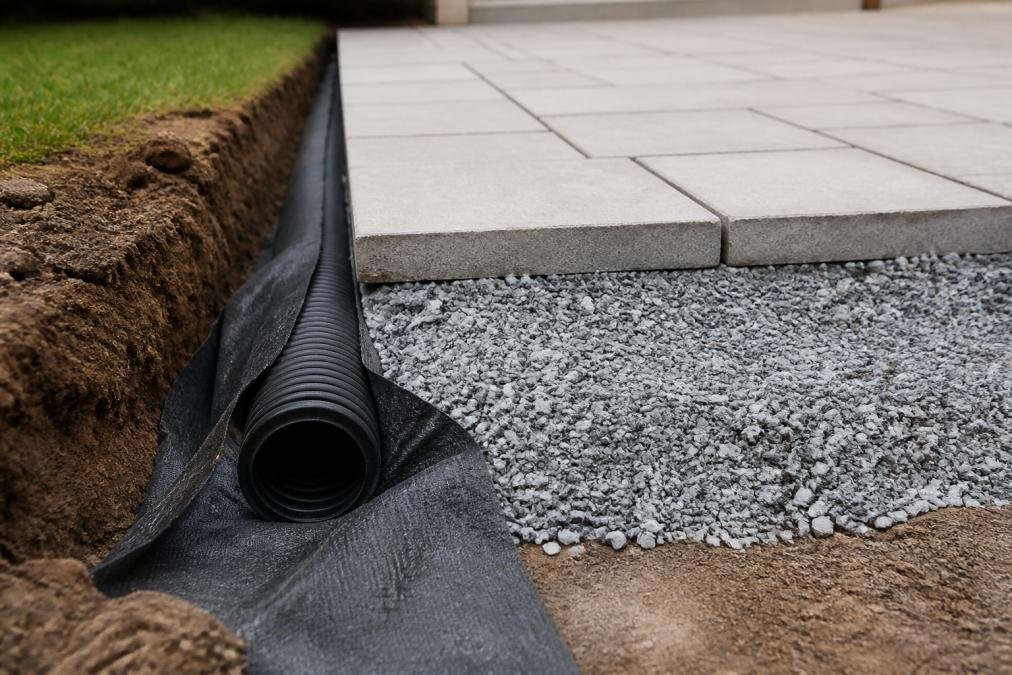
The patio subbase drainage system typically consists of multiple layers: a permeable fabric layer that separates soil from aggregate, a drainage base made of angular crushed stone, and often a dedicated drainage system like French drains or channel drains for problem areas. Most homeowners focus on visible elements and ignore what’s underneath, but the subbase determines longevity. Get it right, and your patio remains level and stable for decades.
Crushed Stone vs. Gravel for Patio Base
Angular crushed stone, typically ASTM No. 57 stone (3/4-inch to 1-inch), is the industry standard for drainage applications (astm.org). The angular shape creates an interlocking structure that resists movement under load and freeze-thaw cycles, leaving consistent void space for rapid water drainage while maintaining structural integrity.
Pea gravel, by contrast, consists of smooth, rounded stones. The rounded surfaces mean less interlocking, and the material shifts and settles more readily under sustained weight or seasonal stress. Pea gravel works for decorative applications or light-duty pathways, but it’s the wrong choice for primary drainage beneath heavy-use patios.
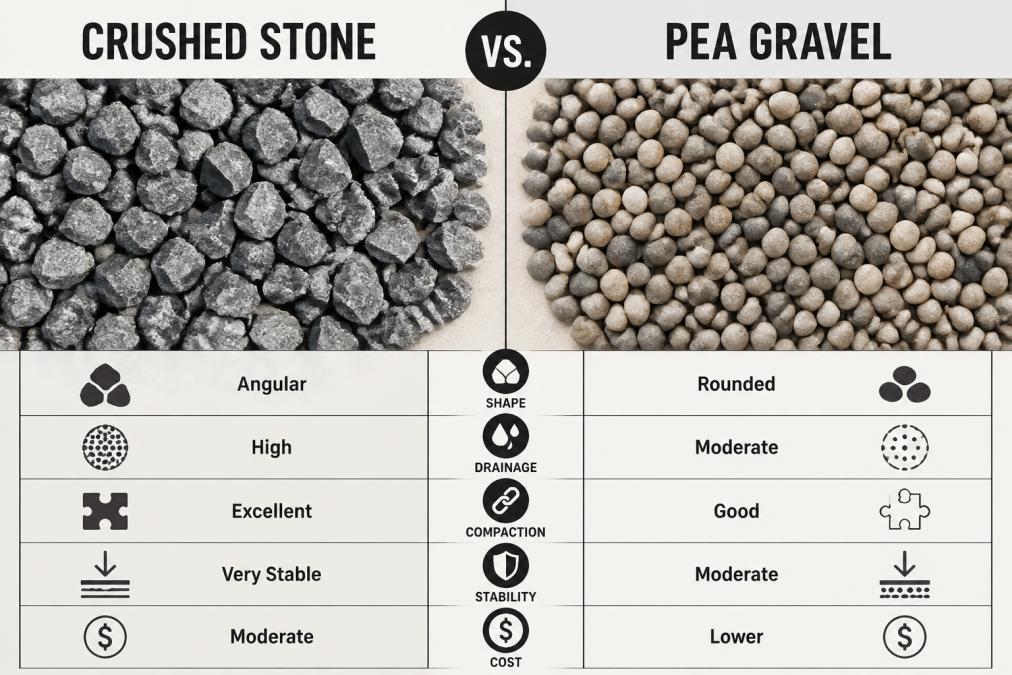
A patio built on angular crushed stone maintains its level surface year after year. A patio on pea gravel as the primary base layer often shows visible settlement and shifting within 3-5 years, particularly in freeze-thaw climates or areas with clay soils.
Crusher dust (screenings) works well as a secondary bedding layer directly beneath pavers due to its excellent compaction, but it lacks the void space needed for effective water drainage. Use it above your coarser crushed stone base, not as your primary drainage layer.
A common mistake is using pea gravel as your primary drainage base. Use angular crushed stone as your main drainage layer, then add crusher dust or sand as a bedding layer if needed.
Patio Subbase Depth Requirements for Optimal Performance
For residential patios with typical foot traffic, patio subbase depth requirements typically call for 4 to 6 inches of compacted base material (icpi.org). This depth provides adequate void space for water infiltration while maintaining structural support. In freeze-thaw climates or areas with clay soils prone to expansion, 6 inches is safer.
Shallow bases don’t provide enough material for proper compaction. A 2-inch base layer simply can’t support a patio long-term. If you’re installing 4 inches of crushed stone plus 1 inch of crusher dust or sand as bedding, you’re at 5 inches total, a solid baseline for most residential applications.
In problem areas with poor natural drainage, heavy clay, or patios sloping toward structures, increase depth to 6 inches of base material plus 1 inch of bedding. Below-grade patios may need 8 inches of base material.
Use a laser level to establish consistent depth across the entire patio area. Inconsistent depth leads to uneven water drainage and settlement.
Geotextile Fabric for Patio Base Installation
A non-woven geotextile membrane is one of the highest-impact upgrades you can make to a patio subbase drainage system. Geotextile fabric separates soil from your aggregate base and filters fine soil particles while allowing water to pass through. Without this barrier, soil gradually migrates into the gravel, reducing void space and drainage efficiency.
Non-woven geotextile comes in different weights, typically 4 oz, 6 oz, or 8 oz per square yard (astm.org). For patio applications, 4 oz or 6 oz is standard. Installation is straightforward: lay the geotextile directly on the prepared subgrade, then place your crushed stone base on top. Overlap seams by at least 12 inches to prevent soil from working through gaps.
The cost of geotextile fabric is modest, typically a few cents per square foot, but the benefit is substantial. Patios installed with geotextile fabric show significantly less settlement and maintain drainage performance for the life of the installation. Patios without it often develop low spots and water pooling within 5-10 years.
Drainage Systems: French Drains and Channel Drains
When surface drainage and subsurface permeability aren’t enough, dedicated drainage systems manage water that would otherwise accumulate beneath your patio.
French drains are subsurface systems consisting of a perforated pipe surrounded by gravel and wrapped in geotextile fabric. The pipe collects groundwater and directs it away from the patio area. Channel drains, also called trench drains, are surface-level systems with grates that collect water running across the patio and direct it into underground piping.
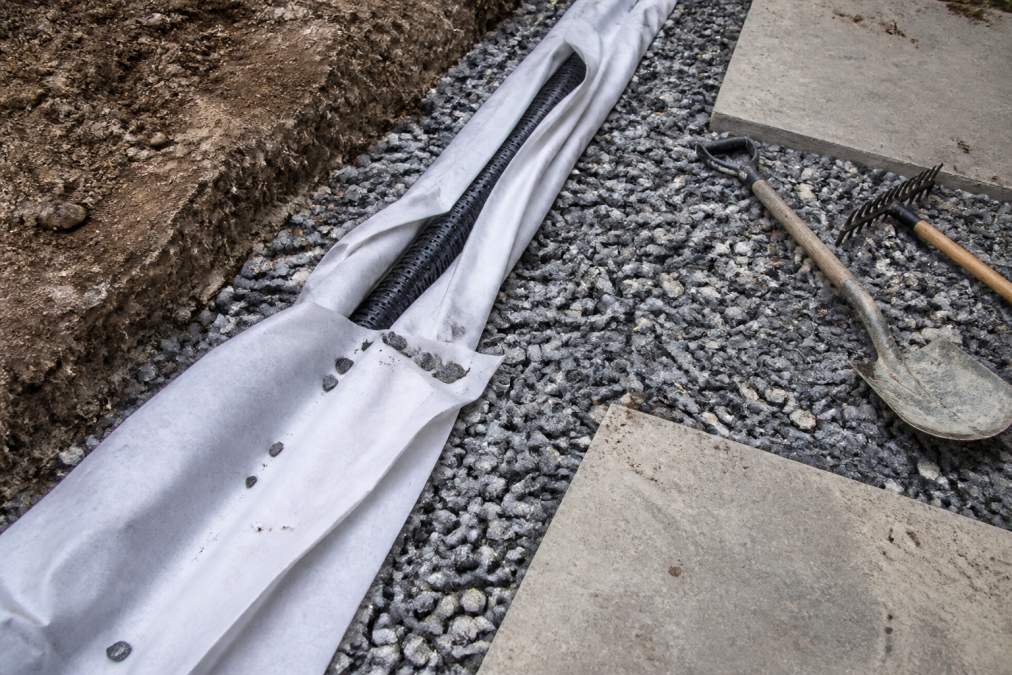
French drains address subsurface water issues and seasonal water tables. Channel drains address surface water, rain runoff, and pooling at low points. Many problem patios benefit from both systems working together.
Perforated drain pipe typically comes in 3-inch, 4-inch, or 6-inch diameters. For residential patios, 4-inch is standard. The pipe must slope toward a discharge point, a dry well, storm drain connection, or daylight discharge to lower ground.
Never install a drain system without a discharge point. A French drain with nowhere to drain is just a gravel pit that fills with water.
Soil Type Compatibility and Climate Considerations
Not all soils drain the same way. Clay-heavy soils are the challenge, clay particles compact tightly, leaving minimal void space for water infiltration. In clay soils, surface water doesn’t percolate downward; it sits on top of the soil layer, saturating your base material from below. This is why geotextile fabric and angular crushed stone are critical in clay areas.
Sandy soils drain rapidly, which is generally positive, but subsurface water moves toward your patio rather than away from it. Sandy soils benefit from French drain systems that actively redirect water.
In freeze-thaw climates, water trapped in your base material expands when frozen, creating heaving and shifting. Proper drainage is critical, you need water moving through and away from the base. Deeper base layers and more aggressive drainage systems make sense in these climates.
In hot, dry climates, drainage is less critical from a saturation standpoint, but proper base preparation still prevents settlement. Coastal areas with salt spray require corrosion-resistant materials or plastic piping.
Common Mistakes in Patio Subbase Preparation
Most patio failures trace back to predictable mistakes during base preparation.
Insufficient compaction is the most common error. Proper compaction requires multiple passes with a plate compactor, typically 3-4 passes, until the material is firm and resists further settling. Undercompacted bases settle and shift within months.
Inadequate depth is equally common. Installing 2-3 inches of base material instead of the recommended 4-6 inches saves time and cost but guarantees problems.
Skipping geotextile fabric to save money creates long-term drainage failure. Without the fabric barrier, soil migrates into the aggregate base, clogging void space.
Poor site preparation leaves high spots and low spots in the subgrade. Water pools in low spots, saturating the base from below. Proper preparation means excavating to consistent depth and verifying uniformity with a level or laser.
No drainage system for problem areas is a setup for failure. If water accumulates in a particular spot, install a French drain or channel drain.
Incorrect slope prevents surface water from draining away from the patio. The patio should slope slightly away from structures and toward drainage points.
Using the wrong material as the primary base layer, such as pea gravel instead of angular crushed stone, compromises long-term stability.
A properly designed patio subbase drainage system is invisible, you never think about it because it works flawlessly. But when neglected, the consequences are visible and expensive: settlement, cracking, water pooling, and pavers shifting out of alignment.
The materials covered here, angular crushed stone, geotextile fabric, proper drainage systems, and appropriate depth, aren’t complicated. They’re proven engineering. The difference between a patio that lasts decades and one that fails within years comes down to getting these fundamentals right.
Alpha Guard specializes in outdoor living spaces designed to perform. Our certified and insured professionals handle site preparation, material selection, and drainage system installation with the precision these systems require. We guarantee structural workmanship because we build our patios to last. If you’re planning a patio project and want it done right the first time, get a free estimate from Alpha Guard and see how proper subbase drainage transforms your outdoor space into a lasting asset.
Frequently Asked Questions
What is the best material for a patio subbase drainage system?
Angular crushed stone (ASTM No. 57 stone, 3/4-inch to 1-inch) is the best primary material for patio subbase drainage. Its angular shape interlocks for stability while creating consistent void space for water flow. Pair it with non-woven geotextile fabric to separate soil from aggregate and prevent clogging. For areas with severe drainage issues, add perforated drain pipes or channel drains to direct water away from the patio structure.
How deep should a patio subbase be for proper drainage?
A patio subbase typically requires 4 to 6 inches of compacted crushed stone for residential applications, though clay-heavy soils may need 6 to 8 inches. The depth depends on soil type, expected load, and local freeze-thaw cycles. Compact the material in 2-inch lifts using a plate compactor to achieve proper void ratio and load-bearing capacity. Always install geotextile fabric beneath the aggregate to improve drainage and prevent settlement.
What is the difference between crushed stone and gravel for patio bases?
Crushed stone has angular edges that interlock, providing superior structural stability and better void space for drainage. Gravel (pea gravel) consists of rounded stones that offer good drainage but shift more easily under weight, making it unsuitable as a primary drainage layer for heavy-use patios. Crushed stone resists movement during freeze-thaw cycles and maintains consistent permeability, while gravel requires strong edge control and is better suited for lighter applications or French drain infill.
Do I need geotextile fabric under my patio subbase?
Yes, non-woven geotextile fabric is highly recommended for any patio subbase. It prevents soil and fine particles from mixing with the aggregate, which maintains drainage efficiency and improves subgrade stability. The fabric filters out fines while allowing water to pass through freely. This separation extends the life of your patio by reducing settlement and paver movement, and it minimizes weed growth beneath joints. Installation is straightforward and the cost is minimal compared to the long-term durability benefits.
This article was written using GrandRanker