
Table of Contents
- Why Verifying Contractor Insurance Matters
- Step 1: Request a Certificate of Insurance
- Step 2: How to Check if a Contractor Is Licensed
- Step 3: Verify Workers’ Compensation Insurance Coverage
- Step 4: Contact the Insurance Carrier Directly
- Understanding General Liability vs. Workers’ Compensation
- Risks of Hiring an Uninsured Contractor
- Your Verification Checklist Before Hiring
Last Updated: August 9, 2026
Why Verifying Contractor Insurance Matters
Hiring a contractor without verifying their insurance is one of the costliest mistakes a homeowner can make. When something goes wrong, you’re potentially liable for injuries, property damage, and legal fees that could reach tens of thousands of dollars.
A contractor’s insurance protects both you and them, covering accidents on your property, damage to your home, and worker injuries. Without it, you’re exposed to significant financial and legal risk. At Alpha Guard, we’ve helped countless McAllen homeowners understand why this verification step matters before hiring anyone for roofing, fencing, or home improvement work.
Most homeowners skip verification because they assume a contractor “looks legitimate.” This is dangerous. Legitimate contractors expect you to verify their insurance, it’s standard practice. If a contractor hesitates or refuses to provide proof, that’s your first red flag.
A contractor without proper workers’ compensation insurance means you could be held liable if a worker is injured on your property. General liability coverage protects you if the contractor damages your home or a neighbor’s property. Without these protections, you’re betting your home and finances on someone else’s responsibility.
Step 1: Request a Certificate of Insurance
The first way to verify contractor insurance is to ask for a Certificate of Insurance (COI). This document, issued by the contractor’s insurance company, proves they have active coverage. Every legitimate contractor should provide it within hours of your request.
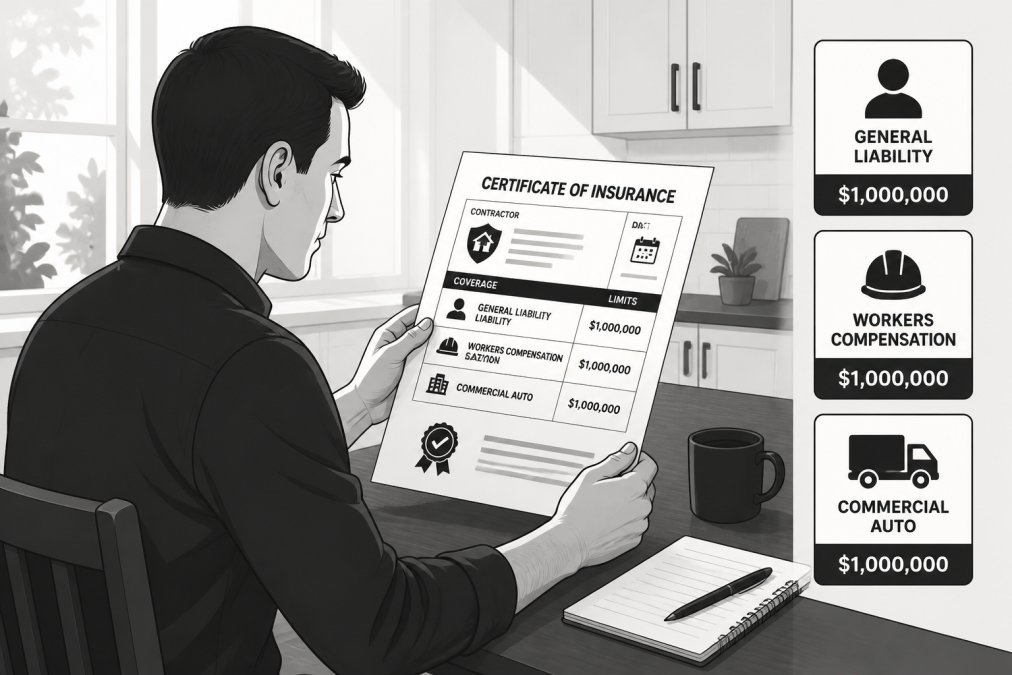
Request the COI in writing via email to create a paper trail. A professional contractor will send it immediately. The document should show:
- The contractor’s business name and address
- The insurance company’s name and contact information
- Policy numbers for general liability and workers’ compensation
- Coverage limits (dollar amounts they’re insured for)
- The policy expiration date
- Your address listed as an "additional insured"
What to Look for on a COI
A valid Certificate of Insurance must be current and extend past your project’s completion date. Check that policy limits are adequate for the scope of work. For roofing or major renovations, general liability coverage should typically be at least $1 million. For smaller projects like fence repairs, $300,000 to $500,000 may be acceptable, but higher is always better.
The most critical detail is whether your address appears as an "additional insured." This means you’re specifically protected under their policy. If you’re not listed, you’re not covered if something goes wrong.
Common Red Flags in Insurance Documents
- Expiration dates in the past. Coverage won’t protect you if it expires before your project ends.
- No additional insured clause. If your address doesn’t appear, you’re not protected.
- Vague or missing policy numbers. Legitimate policies have specific numbers.
- Mismatched business names. The COI name should match the business you’re hiring.
- Generic or incomplete information. Professional certificates include the contractor’s address, phone, and project details.
- Unverifiable insurance company. The company name should be recognizable and searchable online.
Never assume a COI is authentic just because it looks official. Counterfeit certificates exist. Always verify by contacting the insurance company directly.
Step 2: How to Check if a Contractor Is Licensed
A contractor’s license is your second layer of protection. It means the contractor has met state and local requirements, passed exams, and maintains professional standards.

Ask the contractor for their license number, then visit your state’s licensing board website or your city’s building department. Search for the license number or business name. Results should show the license status, issue and expiration dates, and any complaints or disciplinary actions.
If you can’t find the license or it shows as inactive or expired, don’t hire that contractor. For contractors in McAllen, check with the City of McAllen Building Department and Hidalgo County. Note that Texas doesn’t require a state license for general contractors, but individual cities may have their own requirements.
A contractor with an active license has invested in certifications and continuing education. They’re less likely to cut corners because they have a reputation to protect.
Step 3: Verify Workers’ Compensation Insurance Coverage
Workers’ compensation insurance covers medical bills and lost wages if a worker is injured on your property. Every contractor with employees must carry it. Without it, you could be liable for those costs.
When you request the Certificate of Insurance, it should clearly list workers’ compensation coverage with a policy number and expiration date. You can verify coverage through the Texas Department of Insurance (TDI) using the contractor’s business name and federal employer identification number (EIN).
If a worker is injured and the contractor has no workers’ compensation insurance, the injured worker can sue you directly. Your homeowner’s insurance won’t cover this. Ask the contractor directly: "Are all your employees covered under workers’ compensation?" A straightforward yes, backed by a current COI, is what you want. Verify that subcontractors carry their own insurance separately.
Step 4: Contact the Insurance Carrier Directly
This is the verification step most homeowners skip, but it’s the most important. Calling the insurance company directly eliminates doubt about whether the COI is legitimate.
Use the phone number on the Certificate of Insurance, not a number you find online. Say: "I’m a homeowner hiring a contractor. I want to verify that [contractor name] has an active policy with you. Here’s the policy number." The insurance company will confirm whether the policy is active and current.
Request that they email you a verification letter directly to your email address, not the contractor’s. This ensures authenticity and creates documentation.
If the insurance company says the policy is inactive, expired, or doesn’t exist, walk away from that contractor immediately.
Contacting the insurance carrier directly is the only way to 100% confirm a contractor’s coverage is real and current. It takes 10 minutes and protects you from thousands of dollars in liability.
Understanding General Liability vs. Workers’ Compensation
These two types of coverage protect different risks, and both are essential.
General Liability covers damage the contractor causes to your property or a neighbor’s property. If a roofer’s ladder damages your siding or a fence installer hits your sprinkler line, general liability pays for repairs. It also covers injuries to third parties.
Workers’ Compensation covers injuries to the contractor’s employees. If a worker is injured on your property, workers’ compensation pays their medical bills and lost wages. Without it, the injured worker can sue you directly.
Both are required by law in most situations. When you review the Certificate of Insurance, you should see both coverages listed separately with current expiration dates.
| Coverage Type | What It Covers | Why It Matters | Typical Limits |
|---|---|---|---|
| General Liability | Property damage, third-party injuries | Protects you if contractor damages your home or neighbor’s property | $1M-$2M |
| Workers’ Compensation | Employee injuries on your property | Protects you from liability if a worker is injured | Varies by payroll |
| Bonding | Contractor abandonment, incomplete work | Protects you if contractor doesn’t finish the job | 10-50% of contract value |
Risks of Hiring an Uninsured Contractor
The financial and legal consequences of hiring an uninsured contractor are severe. If a worker is injured on your property and the contractor has no workers’ compensation insurance, the injured worker can sue you. Your homeowner’s insurance won’t cover this. A serious injury can cost $50,000 to $200,000 or more.
If the contractor damages your home or a neighbor’s property without general liability insurance, you’re liable for repairs. A roofing mistake requiring a $30,000 roof replacement becomes your responsibility. Without contractor bonding, you have limited recourse if the contractor abandons the project mid-way.
Uninsured contractors often quote lower prices, but that savings evaporates if something goes wrong. The risk isn’t worth the discount.
Alpha Guard maintains full general liability and workers’ compensation coverage for every project in McAllen. Our certified professionals are insured and backed by our guarantee of structural workmanship. When you hire Alpha Guard, you’re protected from day one.
Your Verification Checklist Before Hiring
Use this checklist to ensure you’ve verified a contractor’s insurance and credentials before signing any contract:
- Requested a Certificate of Insurance in writing and received it within 24 hours
- Confirmed the COI includes general liability coverage with adequate limits ($1M+ for major projects)
- Confirmed the COI includes workers’ compensation coverage
- Verified your address is listed as an "additional insured" on the COI
- Checked the expiration date and confirmed coverage extends through project completion
- Called the insurance company directly to verify the policy is active and current
- Searched the state licensing board database and confirmed the contractor’s license is active
- Verified the contractor’s business name matches the name on the license and insurance documents
- Asked about subcontractors and confirmed they also carry their own insurance
- Requested references and contacted at least two recent clients
- Reviewed the written contract and confirmed it specifies insurance requirements
- Obtained a signed estimate that includes scope of work, timeline, and payment schedule
This checklist takes 30 minutes to complete. It’s the most important 30 minutes you’ll spend before hiring a contractor.
Protecting your home starts with protecting yourself legally. Verifying contractor insurance isn’t optional, it’s essential. The small effort you invest upfront prevents catastrophic financial losses later.
When you’re ready to hire a contractor for roofing, fencing, or home improvement work in McAllen, Alpha Guard delivers certified and insured professionals backed by guaranteed structural workmanship. Our team carries full coverage, maintains active licenses, and stands behind every project. Get a free estimate from Alpha Guard and hire with confidence.
Frequently Asked Questions
What should I look for on a contractor's certificate of insurance?
Check that the COI includes the contractor's name, your address listed as an additional insured, policy numbers, coverage limits, and expiration dates. Verify the policyholder matches the business entity you hired. Look for the insurance carrier's name and contact information. Ensure the document is signed and dated by the insurance agent. Any missing information or illegible details are red flags that warrant direct verification with the insurance carrier before work begins.
Is it standard practice to ask a contractor for proof of insurance?
Yes, absolutely. Requesting proof of insurance is standard practice and protects you from liability. Any reputable contractor expects this request and will provide documentation without hesitation. If a contractor refuses or delays providing a certificate of insurance, that's a major warning sign. Professional contractors understand that proof of coverage, including general liability and workers' compensation insurance, demonstrates their credibility and commitment to protecting both you and their workers.
What happens if I hire an uninsured contractor and they get injured?
You could face serious legal and financial consequences. If an uninsured contractor is injured on your property, they may sue you directly for medical bills and lost wages. Your homeowner's insurance may not cover the injury, leaving you personally liable for damages. Additionally, you could face workers' compensation claims even though the contractor wasn't insured. This is why hiring an uninsured contractor risks is so critical to understand before work begins. Always verify coverage before allowing anyone to work on your property.
How do I verify a contractor's insurance policy is currently active?
Call the insurance carrier directly using the phone number on the certificate of insurance. Ask to confirm the policy is active, the coverage limits, and the expiration date. Don't rely on the contractor's word or the document alone. You can also request that the contractor have their insurance agent send you written confirmation of active coverage. For workers' compensation insurance, contact your state's Department of Labor or workers' compensation board to verify the contractor's compliance with state requirements.
This article was written using GrandRanker